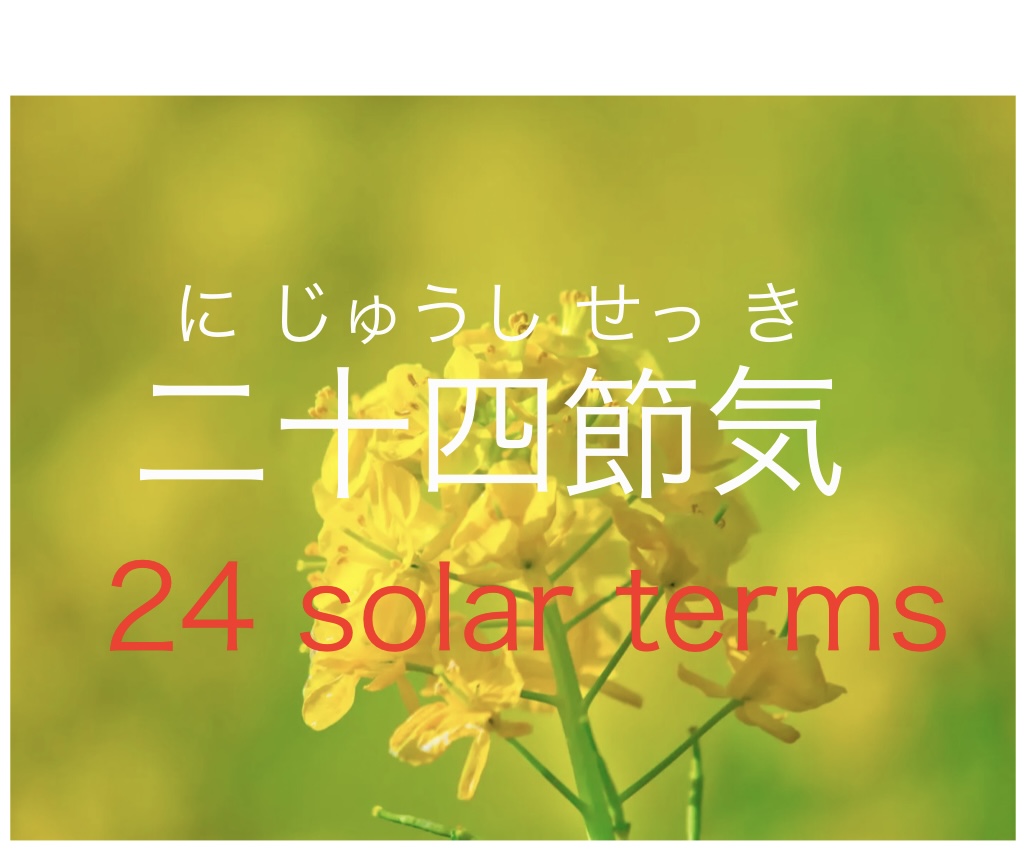

二十四節気について知りたいです。
夏至のときに、二十四節気について書きました。
今回は、もう少し詳しく二十四節気について書きます。
二十四節気というのは、1年を春夏秋冬の4つの季節に分けるだけでなく、それをさらに6つに分けます。全部で24に分けるので、二十四節気といいます。
二十四節気は、12の節気と、12の中気に分けられ、それらに季節を表す名前がつけられています。
この二十四節気は、中国で考えられました。

中国の平原の季節の移り変わりに合わせて、名前がつけられていますので、日本の季節とは少し違うところもあります。
日本には、季節を表す言葉として、「梅雨」がありますが、中国には、梅雨はありません。
ですから、二十四節気の中には、梅雨という言葉はありません。
2011年ごろに、日本気象協会は、現代日本の気候に合わせた新しい二十四節気を作ろうとしました。
しかし、紛らわしくなるからという理由の反対意見が多く、この計画はなくなりました。
二十四節気では、一年の中で、一番昼が長く、夜が短い日を「夏至」と言います。
反対に、一年の中で、一番夜が長く、昼が短い日を「冬至」と言います。
昼と夜の長さが同じ日は、年に2回あり、それぞれ「春分」と「秋分」と言います。
冬至と春分、春分と夏至、夏至と秋分、秋分と冬至の間の日を、「立春」「立夏」「立秋」「立冬」と言います。
そして、「立春」から、一年が始まることにしました。
⭐️ ⭐️
関係する言葉についても読んでください。
夏至 summer solsticeにすすむ(このブログにあるページ)
冬至 winter solsticeにすすむ(このブログにあるページ)
節分 Setsubunにすすむ(このブログにあるページ)
24 solar terms
At the summer solstice, I wrote about 24 solar terms.
This time, I will write about 24 solar terms in a little more detail.
Twenty-four solar terms not only divide the year into four, spring, summer, autumn and winter, but also divide it into six. Since it is divided into 24 in total, it is called 24 solar terms.
Twenty-four solar terms are divided into twelve solar terms and twelve middle terms, and they are given names that represent the seasons.
This solar term was considered in China.
The name is given according to the changing seasons of the plains of China, so there are some differences from the seasons of Japan.
In Japan, there is “tsuyu/rainy season” as a word to describe the season, but in China, there is no tsuyu/rainy season.
Therefore, there is no word “tsuyu/rainy season” in the 24 solar terms.
Around 2011, the Japan Weather Association sought to create a new solar term for the climate of modern Japan.
However, there are many dissenting opinions because it is confusing, and this plan has disappeared.
In 24 solar terms, the day with the longest day and the shortest night of the year is called the “geshi/summer solstice”.
On the contrary, the day with the longest night and the shortest day of the year is called the “touji/winter solstice”.
There are two days a year when the length of day and night is the same, and they are called “shunbun /spring equinox” and “syuubun/autumn equinox” respectively.
The days between the winter solstice and the spring equinox, the spring equinox and the summer solstice, the summer solstice and the autumn equinox, and the autumn equinox and the winter solstice are called “risshun/Rising spring”, “rikka/Rising summer”, “rissyuu/Rising autumn”, and “riotous/Rising winter”.
And people decided to start the year from “Rising spring”.
コメント